“The good, the bad … the generous, the cruel … the hermit, the teetotaler … the black, the white, and the endless gray in between. You know, it’s been said that you should never meet your heroes, but I say better to know whom you place on that pedestal, don’t you agree?” – Jonathan Edward Durham, Winterset Hollow
 WITH HIS debut work, Winterset Hollow, Jonathan Edward Durham crafts a novel that initially appears to be a whimsical homage to children’s fantasy literature but gradually reveals itself as something far darker and more politically incisive. Beneath its pastoral imagery and storybook charm lies a brutal allegory, one that confronts not only animal rights but also colonialism, cultural erasure, and the systematic exploitation and extermination of Indigenous peoples. I praise Durham’s ability to weave these themes into a narrative that feels at once fantastical and horrifying, childlike and deeply adult when the veil of innocence is ripped away.
The book follows a group of friends who travel to a remote island to celebrate their love for a fictional children’s book series. The island, once home to the reclusive author of those beloved tales, seems to have sprung directly from the pages of a pastoral fantasy. The fact that these visitors are greeted by an anthropomorphic talking rabbit sets every conceivable notion of normal on its floppy ear!
The setting possesses that “Wonderland” quality of dream logic and uncanny displacement, where the familiar becomes unsettling and innocence turns to menace. The whimsy quickly evaporates and the reader’s initial comparisons to Alice’s Adventures in Wonderland (even Kenneth Grahame’s The Wind in the Willows), start to fade, quickly replaced by Durham’s darker, more sinister tone.
But while Lewis Carroll’s world is absurdist and mischievous, Durham’s is predatory. The animals the protagonists encounter are not charming caricatures; they are cultured, articulate, and harbour deep hostility towards human society, which is well known for its predatory, consumptive nature. The sword does cut both ways when prey becomes predator. And these intelligent animals have every right to feel as they do, as the reader will soon see. They are deeply wounded, most in body, all emotionally. What initially feels like playful fantasy transforms into pure horror as the island’s current power dynamics come into focus. In this inversion, humans are no longer the unquestioned masters of the natural world, not on this island. At least, not anymore.
Now we see the novel’s allegorical power. By positioning humans as the hunted, Durham forces readers to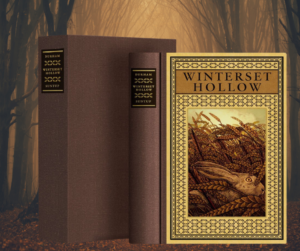 confront the normalized brutality embedded in industrial farming, even hunting for sport and materialism. The polite dinner table conversations of the animal gentry become chilling mirrors of our own euphemisms around slaughter and consumption.
In doing so, Durham does not rely on didacticism; the message is not lost due to obvious moralizing. He trusts the structural reversal to generate moral unease organically. The horror emerges not from gore alone but from the reader recognizing what is always there in front of their face, a part of our lived reality, whether they choose to acknowledge it or not. (Image on Right: signed limited edition hardcover of Winterset Hollow featuring colour illustrations by Maura OConnor).
Yet to read Winterset Hollow solely as an animal rights parable would be to miss the breadth of its social critique. The island functions as a microcosm of colonial history. I don’t wish to give too much away, so I will say that there is a strong link to a culture forever changed by conquest and displacement. Regarding the animals the visiting humans encounter, their initial civility masks a violent origin story. As the dark truth of the island’s past surfaces, the narrative exposes how colonial powers often cloak domination in the rhetoric of refinement, order, and moral superiority. And never forget how easy it is for unscrupulous people to lie and deceive. The animals’ rationalizations for their actions are so much more than simple revenge, though they have every right to it. The horror lies not just in the violence itself but in the motivation behind it.
 This thematic layering recalls the original tenor of Grimm’s Fairy Tales, before those stories were sanitized for modern children. The Brothers Grimm collected tales that were brutal, punitive, and morally uncompromising. Violence in those stories was not accidental; it was instructive and symbolic. The animals’ genteel speech and ritualistic feasts carry the cadence of nursery tales, yet what they describe is slaughter. That done by them—and done to them! This is the crux: justification vs justice.
Winterset Hollow is not written for children, even though it borrows the framework of children’s fiction. Its protagonists are adults, grappling with nostalgia and the desire to reclaim childhood wonder. Durham weaponizes that nostalgia. The very act of returning to a beloved fictional world becomes dangerous when the fantasy is ripped away to reveal the harsh reality.
The novel suggests that yearning for simpler times, comfortable narratives, and stories where good and evil are neatly arranged can blind us to the moral complexity of the real world. Truth is not just stranger than fiction, it is far more insidious. The characters’ affection for the idyllic tales leaves them unprepared for the violence that awaits them.
 Stylistically, Durham excels at tonal dissonance. Lush, pastoral descriptions are undercut by moments of grotesque narrativity. His words oscillate between lyrical and clinical, mirroring the novel’s thematic tension between fantasy and realism. This duality reinforces the sense that the story exists in two worlds at once: a child’s storybook and an adult nightmare.
Ultimately, Jonathan Edward Durham’s Winterset Hollow is a daring tribrid: dark fantasy, political allegory, and slasher horror intertwined. It is an adult novel masquerading as a children’s tale, much as colonial histories often masquerade as civilizing missions.
By inverting the roles of predator and prey, Durham dismantles comforting assumptions about dominance and entitlement. The result is a work that lingers long after its final page, a reminder that the most terrifying stories are those that expose the violence woven into the fabric of our own world.