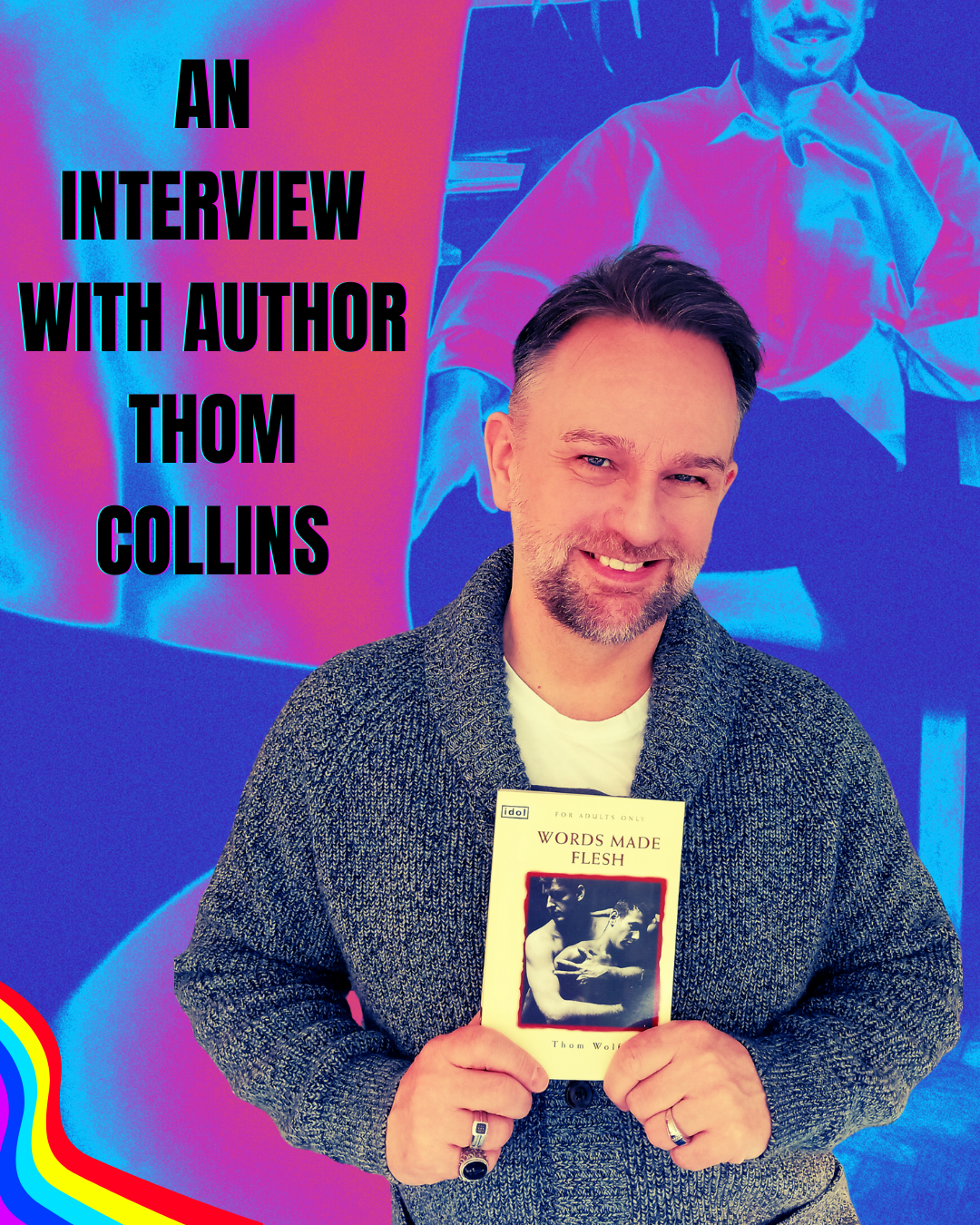
Thom Collins: “I write what interests me, and I don’t censor myself.”
 I WANT to welcome author Thom Collins to the Blog. His work weaves thriller-style tension beautifully with gay romance; the growing attraction between his male protagonists is never a side narrative but central to the danger surrounding his protagonists, shaping the emotional core of the story and intensifying its suspense.
Alongside creating complex, sexy characters in brilliantly crafted worlds of desire, intrigue, and peril, Thom is happily married and lives in Durham, North East England, with his husband.
Thom’s body of work includes the gay erotic thriller series Basic Instincts, as well as the more gay romance–driven thriller series Anthem and Jagged Shores. His career also includes several standalone novels, including his first work under the name “Thom Collins,” Closer by Morning (2016), and Show No Mercy (2024), as well as novellas, among which my favorite is Silent Voices (2017).
In this interview, Thom and I discuss various topics, including his creative process, his passion for erotic thrillers, and how he navigates the delicate balance between (gay) romance and violence in his writing.
My reviews of several of Thom’s novels can be found in earlier blog posts.
Thom, when you reflect on your writing journey, both as an outlet for creative expression and as the first step toward a career, who or what emerges as your deepest source of inspiration? Was there a clear moment when you decided to move from writing just for yourself to publishing, or did that shift happen gradually? What was it like the first time you shared your work publicly, and how do you deal with the vulnerability and the anxiety that come with sharing your work with a global audience, many of whom are ready to praise, critique, and judge?
 I always wanted to be a writer, but I went to such a bad school that it was never encouraged. When I spoke to the career advisor about it, instead of putting me on the path to taking the right courses and going to university, they suggested I get a job in a shop. I’m not knocking retail work; like most authors, I’ve done plenty of it, but it wasn’t the most encouraging start. So, I left school at 16 with basic qualifications, but I never stopped writing. In those days, I wanted to be a male Jackie Collins. I tore through all of her books, and those were the kind of page-turning stories I tried to write.
Fast forward a few years, I had a boyfriend who had a massive collection of porn magazines. This sounds like a cliché, but I used to read all the stories and articles in them. Each issue would have two or three erotic shorts. In 1992, Madonna released her SEX book, and while everyone was gagging over the naked photos, I devoured every word of the text and thought: I could do this. I started writing the kind of erotic stories I read in the porn mags.
Eventually, I submitted one to a UK magazine called Overload. I think I was only twenty when that was accepted for publication. It was a massive thrill when the issue came out. I bought multiple copies and shared them with all my gay friends. I had no anxiety at all. I was so excited to be published and didn’t care what anyone thought about what I’d actually written. That’s the arrogance (and joy) of being twenty.
After that, I started submitting to the big American magazines, and once those were accepted, I was on my way, churning out one story after another. It helped that I had a very dirty mind back then and no hang-ups. That stuff was pure filth.
You began your prolific fiction career in the ’90s, writing gay erotica under the name Thom Wolf before transitioning to gay/queer thrillers and romance under your current moniker, Thom Collins. 2016’s Closer by Morning, from Pride Publishing, marked your first work published under this new name. Was the move driven by a desire to craft more complex, narrative-driven stories while also broadening your audience commercially? How has your approach to storytelling evolved across genres? Are there lessons or themes from your earlier sexually explicit work that continue to shape your current writing?
Having left school with few qualifications, I spent a bit of time studying with the Open University and completed a diploma in creative writing. It was on the back of that course that I wanted to broaden my horizons. I wanted to write more novel-length fiction, and that is a very hard format for erotica. I’d previously written three erotic novels that required a sex scene in every chapter as well as moving the story forward, and I didn’t have another one in me.
I’ve always loved the erotic thriller genre, so Closer by Morning was my first attempt at a murder plot that also contained a significant amount of sex. But with that one, I was very conscious of not making it too much like porn. So much so that the editor suggested I needed to add more sex scenes once it was done. I just wanted to write a book I could tell all my family and friends about, and not just the gays. But there will always be sex in my writing because that’s what interests me. I love reading sexy books and watching sexy movies–that hasn’t changed at all as I’ve gotten older.
Your stories place gay/queer characters in real danger, where secrets, fear, and desire collide, typically under threat of physical harm, even death. What attracts you to writing thrillers where gay romance unfolds in those high-stakes moments? As an own-voice author, how do your personal experiences as a gay man shape the way you write vulnerability, survival, and emotional connection when everything is on the line? How does your sexuality influence the characters you create, the dynamics of their relationships, and the themes you choose to explore?
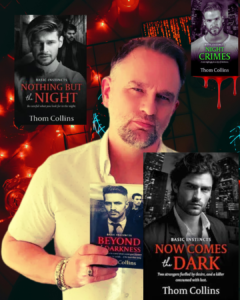 To be completely honest, I don’t consciously take those things into consideration. I like to plot out the thriller elements and create characters that interest me, then the rest of it just comes out. It’s obviously influenced by my own experiences. I’m fifty-two and came out in an era that was not as tolerant as it is now.
Queer bashings and homophobia were all part of going out to bars. There were no apps, so we hooked up with men in dark parks. Most of the time, you couldn’t see what they looked like and had to feel your way. If you chatted up a man at the bar, there was always a chance that you’d judged the situation wrong and he’d turn on you. Those informative years were quite dangerous, so I suspect that feeds into what I do now.
On the other hand, I’ve been with my husband for thirty years, and I have no desire to write about happily married middle-aged guys. I write to entertain myself as much as anything. It’s an escape, so I go for the things that excite me.
Violence is a core part of the thriller genre—political, spy, and legal thrillers all rely on it. But queer thrillers have a trickier path to navigate. Like queer horror, they can trigger LGBTQ+ readers who’ve faced real-world violence or trauma because of their sexuality or gender identity. Your work, especially the Jagged Shores and Basic Instincts series of books, includes storylines involving hate crimes, partner/spouse abuse, violence against gay sex workers, and grudges that lead to attacks on gay men.
Do you feel that, as a gay man, writing in this genre, you have a special responsibility to handle this content with extra care, or does that expectation risk being unfair and creatively stifling? How do you approach depicting violence toward gay/queer characters in your work, and what strategies do you use to balance authenticity and sensitivity while still producing quality fiction that is both creatively thrilling and marketable to an LGBTQ+ audience?
As I mentioned earlier, I came out at quite an intolerant time for queer people. My day job is within the Criminal Justice System. So, I suspect that I have a warped view of these things. I deal with cases of violence every day. To me, it’s everywhere, and I have to keep reminding myself that things aren’t always that bad. The climaxes of my books are always a bit OTT, but a lot of the stuff that leads up to it is taken directly from real life.
I suffered PTSD a few years ago when a guy we were supervising developed an unhealthy fixation on me. It resulted in him breaking into the office and setting fire to my desk. The aftermath of that left me with a lot to deal with. The fire gutted the office, and we didn’t get back for almost a year. He later went on to stab another man in the neck, which triggered all sorts of feelings I wasn’t equipped to cope with at the time. I suspect a lot of what I write is probably just me working through my own issues. The PTSD experience has definitely fed into some of my characters.
I don’t feel any expectation to handle it sensitively. All the books come with trigger warnings, so I don’t let that get in the way when I’m writing. I let it all pour out, but if an editor later told me that something was too much, I wouldn’t hesitate to change it. I want readers to be entertained, not traumatized.
Continuing this line of discussion, action and violence are standard components of the thriller genre, whether queer-focused or not, and your writing often leans into vivid, visceral imagery. Early in your novel, Now Comes the Dark, the first book in the Basic Instincts series, the main character, Roman Ballentyne, is the victim of a hate crime and is severely beaten. Were there moments in this book—or in any of your series—where you felt the violence became too graphic and chose to revise, reduce, or remove scenes?
More broadly, do you believe there is a line that can be crossed when depicting violence in thrillers—particularly in queer narratives—or do you see the genre as one where few boundaries exist as long as the violence serves a clear narrative purpose? And to what extent can romance and violence coexist in this type of thriller fiction without one diminishing the impact of the other?
 That first Thom Collins book, Closer by Morning, was marketed as a romance, and there’s one particular incident in there that some readers found upsetting. Looking back, I can see that it verged into horror and was too much for a romance book, even one that was tagged as a thriller with lots of trigger warnings. It was also written while I was still working through my own issues, so I probably did go too far at the time. I try to match the violence to the audience. If I ever wrote a horror novel, I would go a lot further.
I sometimes feel a bit of a fraud when I’m marketed as romance because the thriller elements are more exciting to me. I have written a handful of things that were pure romance, no murders or psycho stalkers, but I didn’t connect to those stories in the same way or particularly enjoy writing them. It felt less authentic. Like I was trying to conform too much.
As for boundaries, it’s not something I actively think about. I write what interests me and don’t censor myself. I can’t think of an instance when I’ve felt the need to tone something down or have been asked to.
Working in the thriller genre, you know that pacing and tension are key to a story’s success. We all love that big “AHA!” moment at the end, but it’s the thrills and chills along the way that really make or break a novel. How do you create that? Do you plot your significant terror and revelation moments in advance and build suspense around them, or do you start with a general idea of where you’re headed and let the anxiety and anticipation develop organically, putting yourself in the shoes of both writer and reader as you go?
I plot and outline everything, even short stories. I can’t start until I know exactly what’s going to happen and how it will end. I usually brainstorm a few ideas, then develop them into a thirty-point plan. That’s where I figure out the highs and lows of the plot and try to make it like a roller coaster ride. Then I do all the character work, and then a chapter-by-chapter breakdown. Once I’m happy with all of that, I’m ready to start. I’m quite a control freak. I’m the kind of person who goes on holiday and has every moment of the day planned to a timetable, and I’d get really anxious if it started to run behind. I’m exactly the same with books. Planning is everything.
Plotting in advance really paid off last year. I’d just started writing the fourth Basic Instincts book when my dad’s health took a massive downturn. Suddenly, all my priorities changed, and I didn’t have a dedicated day each week just to write. It was an hour here, a couple of hours there. Some weeks, I didn’t write at all. But because of the detailed outline, each time I picked the book back up, I knew exactly where I was, what was happening and where it was going next. If I’d been pantsing, I would have given up on the book entirely and not started again. It took twice as long as my usual first draft, but because of the outline, it got finished.
I get a sense that, like me, you’re a fan of the ’90s cinematic “erotic thriller” genre, with Sharon Stone and Basic Instinct being standouts for us. I mean, you have a series you titled Basic Instincts, which is fabulous, btw! What inspired you to push the erotic elements in your storytelling further and embrace a darker, more violent tone with your Basic Instincts series? This seems especially noteworthy compared to your Jagged Shores and Anthem series, where romance tends to take the lead over the more sexual and violent aspects.
Looking back at your earlier gay erotica work, do you feel that explicit sexual content can distract from the core story or automatically shift a book into the “erotic thriller” sub-genre? Would you classify the Basic Instincts series as gay erotic thrillers, and have you ever worried that sexually charged narratives might be taken less seriously than straightforward nail-biters?
To say I love Basic Instinct is a huge understatement. It’s my favourite movie of all time. When it was first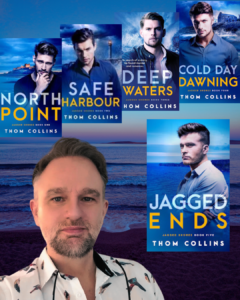 released, it blew my mind. I think I saw it six times at the cinema that spring and summer. Then I’ve owned it on every available physical media format in the years since, together with books, soundtracks, and posters. I even love the berated sequel from 2006. [I’m obsessed with the sequel. We should talk.] I wish we’d gotten loads of sequels. The first time I went to see it was on a date, and the guy I went with didn’t enjoy it at all. That was the end of him.
My first pen name, Thom Wolf, was inspired by Catherine Trammell’s pen name in the movie. [I made the connection immediately—love it!]
I’d always wanted to write erotic thrillers and had a minor go at it with Closer by Morning. But the genre was so out of fashion, and I thought I was the only person who still liked them. After the Anthem and Jagged Shores books, I just thought fuck it. I’m going to do one. I actually wrote Now Comes the Dark between Jagged 4 and 5. It was entirely for my own pleasure, and I was certain I’d have to self-publish it as my publisher wouldn’t be interested. After Jagged Ends, my editor asked what else I was working on, and I sent her the book to get her opinion. If she’d asked me to make a lot of changes and tone everything down, I was going to stick to the original plan and self-publish, but she loved it as it was. I got a contract for it about three days after I sent it to her. It was very fast. I thought it was pushing my luck calling the series Basic Instincts, but then why not? That movie has probably influenced me more than anything else.
I wouldn’t classify the series as anything other than gay erotic thrillers. I’m proud to be writing them, even if no one else is. As for being worried about not being taken seriously, the genre has never been taken seriously by the majority of people. Even the big hitters like Basic Instinct, Body Heat and Fatal Attraction are sneered at. I don’t care. I love them and would write them just for myself.
I’d love to see a return to big-budget erotic movies. There have been a couple of attempts over the last few years, but they didn’t go anywhere. It seems like Hollywood is afraid of putting sex in the cinema. There’s plenty of sex on streaming services, but a raunchy TV show isn’t the same as a twisty, sex fueled movie. I’m a big fan of the French film Stranger By The Lake. That’s the closest I’ve seen in recent times to getting anywhere near what I want to see.
In many of your novels, nautical settings act as rich emotional landscapes, from the Atlantic coastline between England and Portugal in Anthem of the Sea, the first in your Anthem series, to the fictional fishing town of Nyemouth on England’s North-East coast in your Jagged Shores series, with North Point and Safe Harbour being personal favourites of mine. The vast expanse of open water, together with cliffs, headlands, and pebbly beaches, blends with solitude and reflection to create a vivid atmosphere that carries real emotional weight, evoking freedom, isolation, danger, and even the possibility of rebirth—a second chance at love.
How do these backdrops serve your characters and shape their emotional journeys, and in what ways do you use sensory details to heighten the romance, suspense, or tension in your stories? For instance, the cove scene with the incoming tide in the latter half of North Point is charged with tension. While there’s the obvious connection to England and English characters, do you also feel a personal affinity for the sea or for seaside living?
 It’s just a case of writing what you know. I grew up in a small seaside town. My parents’ house is about sixty yards from the beach. I spent my childhood playing in the bay or among the rocks and caves, and my dad was a fisherman. The sea has always been in my blood. I live a little way inland now, but the move was always on the condition that when we retire, we’ll sell up here and move back to the coast. I’m hoping that will be within the next ten years.
The Jagged Shores books are set in a fictional town in the area where I grew up. I don’t consciously think about how the setting reflects the characters’ journey. It’s more that I see the stories in my head, like a movie, and translate that to the page. I do things more intuitively rather than overthinking it.
I hate flying these days too, so whenever I go abroad, it’s always by ship or ferry. I just love being on the water. I had a Reiki session this morning, and afterwards, the therapist asked if I had any naval connections. He said the whole time he was giving the treatment, he kept getting images of the sea coming off me. The sea is in my blood.
What is the best and the worst advice you’ve ever received about writing or publishing? Based on your own experiences and lessons learned, what guidance would you give to other authors, whether they’re tackling thrillers, queer fiction, romance, or writing in general?
Write what you love. If your heart isn’t in it, if you’re writing to a market just because that’s what’s currently popular, it will show. And you won’t enjoy the experience. The joy for me is actually writing the first draft, letting the story unfold. Everything else, including being published, is a wonderful bonus, but the real pleasure is in the writing.
The best advice I got was around the time I was doing all those Open University courses. Because I felt like I’d been denied a good education, I felt pressure to get a degree before I’d be taken seriously.
It was just as I completed the creative writing diploma that I told a successful writer about the course I was intending to do next. And he told me not to bother. He said, “You’ve learned all you need to know about processes; now you need to put it into practice.” He was right, too. Rather than sign up for the next course, I wrote Closer by Morning. And I think this advice might have come from Jackie Collins: You have to finish what you’ve started. You can’t publish an incomplete manuscript, so make sure you finish your WIP’s. A folder full of unfinished novels and stories is no good to anyone.
Worse advice? I’ve forgotten it. I’m so old now my brain only wants to remember good things, so it junks the shit.
Thom, what book(s) are you currently devouring? Do you have a preferred genre, or are your reading preferences quite diverse?
I’ve just finished Whitley Strieber’s The Hunger, which I loved. It was very different from the old Tony Scott movie. And I’ve just begun a re-read of Anne Rice’s Queen of the Damned. I’m into all things vampire at the minute.
I’d say I read quite broadly, but I tend to gravitate to horror and thrillers. Your Haunted Hearts book, I Will Always Find You, is on my current TBR pile. I visited Pompeii for the first time last year and can’t wait to discover your epic story that begins there. [To say I’m flattered is an understatement.] Some of my favourite authors are Jackie Collins, Harlan Coben, Stephen King, James Herbert, Paul Tremblay, Kristian Parker, Eric LaRocca, Alan Hollinghurst, Melanie Blake, Ian Fleming and Guy N Smith.
Those are all established names, so I do try to dip into unknown authors too, and I usually alternate every fourth or fifth novel with an autobiography. I also listen to audiobooks at the gym and on long car journeys, but I find biographies much easier to follow than fiction when I’m doing something else at the same time.
So, what does the future hold for author Thom Collins? Can we expect even more danger and eroticism in your upcoming work? Or perhaps a 180-degree turn toward a cozy Christmas or autumnal romance is on the horizon? Give your fans a little glimpse into what’s next!
Ha ha. You can certainly strike cozy off the expectation list. And I’d only ever write a Christmas book if it involved a Santa slasher or an orgy. The fourth Basic Instincts is out in July, then I have one more book to complete the series. I’ve got some great ideas for the last book: for new characters and to bring back some older ones. To maybe kill some of them off. It’s still at the ideas stage, but I want it to be bigger, sexier and a lot darker for the series to end on a bang.
Before I start work on book 5, though, I want to take a month to write a vampire novella. It will work as a tester for a potential new series. It’s something I’ve wanted to do for a long time, but I’m not sure what form my vampire series would take. I’ve already mapped out the rules and lore for the vampires and have developed a handful of characters already, but I’m unclear about the direction it will take.
It will definitely veer more towards horror. I’m pretty certain it won’t be a paranormal romance. But I can’t decide exactly which direction to take it. At the minute, I’m inclined to go with a trilogy storyline, centred around a central couple. There will be sex, there will be violence, the vampires won’t be cozy or sparkly, but other than that, it’s all to be determined. This novella will be an experiment to feel my way through it. It will likely never see the light of day, but it will help me decide where to go next. That’s the reason I’m reading a lot of vampire fiction right now. I want to get a feel for what I like and what I don’t in the genre, and I’m already gravitating towards horror more than Romantasy or Paranormal MM.
I decided at the end of 2025 that I wanted to challenge myself and do something new. I adore writing erotic thrillers and will continue to do so even when the current series ends, but I’m ready to go down another road. The vampires books could require a whole new pen name. I don’t know, and that’s what’s exciting me right now. I don’t intend to even submit to a publisher until I’ve written at least two books, so I’m not influenced to tone anything down.
Last year forced me to slow down, and as a result, I took stock. I’ve been writing two books a year for the last ten years, and I want to ease up on that a little. Take some time to enjoy it more rather than meeting the next deadline. Experiment more.